
By Tom Wolf
If you want to know more about the future of weed management, it’s sometimes instructive to look at scientific weed science society annual meetings. Most relevant to Canada are two societies: the Canadian Weed Science Society (CWSS), covering all of Canada, and the North Central Weed Science Society (NCWSS), covering the midwestern U.S. and Canada.
These societies report on research that is often funded by local commodity groups, provincial, state and federal governments, as well as private corporations that manufacture and sell inputs. The funding priorities of these groups are a good indicator of where they think we ought to be headed. We also get a chance to see some innovative ideas that might not be ready for prime time.
In this first part of two articles, we look at NCWSS. This is the largest of the regional weed science societies in North America, and it held its annual meeting in Grand Rapids, Michigan, this past December. In all, 235 posters and presentations were listed in the proceedings. They tend to focus on corn and soybeans, with less work on the common grain and oilseed crops grown in Western Canada.
The proceedings were divided into major crop groups, each addressing unique weed control challenges. Researchers also submit their research into special sections for integrated weed management, cover crops, weed biology, weed genetics and herbicide physiology as well as application technology for research that is not directly related to a commodity.
As might be expected, a majority of presentations at NCWSS dealt with herbicide technologies. How effective is herbicide A on weed B in crop C? These types of questions are driven by registrants and commodity groups looking for answers to specific weed issues in particular regions of interest, and these questions have been the basis of so much “weed science” research in the past 50 or more years. The meeting also saw new herbicide mixtures, as well as integration of residual strategies with post-emergent products. These were typically geared toward the control of herbicide-resistant weeds.
There was one new herbicide announcement: a Group 23 mode of action (microtubule inhibition). The product, icafolin-methyl, is manufactured by Bayer CropScience and will be used for non-selective weed control across a broad range of crops (soybean, cereals, pulses, oilseed crops, as well as pome and stone fruits, tree nuts, grapes and citrus) for pre-emergent /preplant burndown of difficult to control grass and broadleaf weeds.
Icafolin will control all known resistant biotypes of labelled weeds and is intended to be used along with other modes of action to delay the onset of resistance. It is currently being evaluated by PMRA and EPA. It should be noted that Group 23 products were first brought to market in the 1950s but have not been used recently in the central Great Plains. Barban (carbyne) was a groundbreaking wild oat product belonging to this mode of action group in its day.
Bayer CropScience also introduced Convintro, a herbicide containing diflufenican (Group 12). Diflufenican has been used in other countries for several years, but its introduction to North America will offer a new active ingredient for control of pigweed species in corn and soybean, pending EPA approval.
A new instance of resistance was reported: a giant foxtail population in Illinois resistant to Group 15 herbicides (in Western Canada, pyroxasulfone: Zidua, Fierce, Authority Supreme, Focus, etc.). In lab studies, the resistant biotypes were tenfold more resistant than their susceptible counterparts; under field conditions the fourfold rate only provided 70 per cent control. Will resistance ever go away? No, it will not. It will steadily grow worse.
Cover crops were a popular topic at this NCWSS meeting, with over 26 posters and papers dedicated to the subject matter. The research questions revolved around cover crop type, the timing and method of termination, and integration with residual herbicides. Generally, the use of herbicides in addition to cover crops enhanced weed control. But with proper timing of establishment and termination, cover crops are proving to be a very effective means of weed suppression.
There was significant reporting of application technologies, with several studies comparing various spot spray technologies and identifying nozzle systems that provided best results. For spot sprays, an arrangement of three adjacent, overlapping nozzles provided better targeting and weed control than a single nozzle passing over weeds located directly under the central nozzle. Lower booms also improved control for both arrangements. Weeds as small as five-millimetre diameter were detected by the One Smart Spray system used in the studies.
In another study, ultra-precision herbicide sprays applied in a six-centimetre by six-centimetre grid permitted the use of non-selective herbicides within a row crop. When used in conjunction with a good pre-emergent herbicide program, good weed control and minimal crop damage were achievable.
Comparing different broadcast and spot spray strategies, one study showed that crop yields were highest with the spot spray compared to the broadcast treatment, on account of less crop phytotoxicity from the broadcast application. Think Sencor on pulses. Less drift was also documented for the spot sprays.
The use of residual pre-emergent herbicides was critical in setting up for spot spray success in the post-emergent pass. Better residual control resulted in lower weed densities to be managed with the post spray, allowing for greater post-emergent herbicide savings. Although residual herbicides are less common in our small-seeded cereal and oilseed crops, there are some options and they are worth investigating.
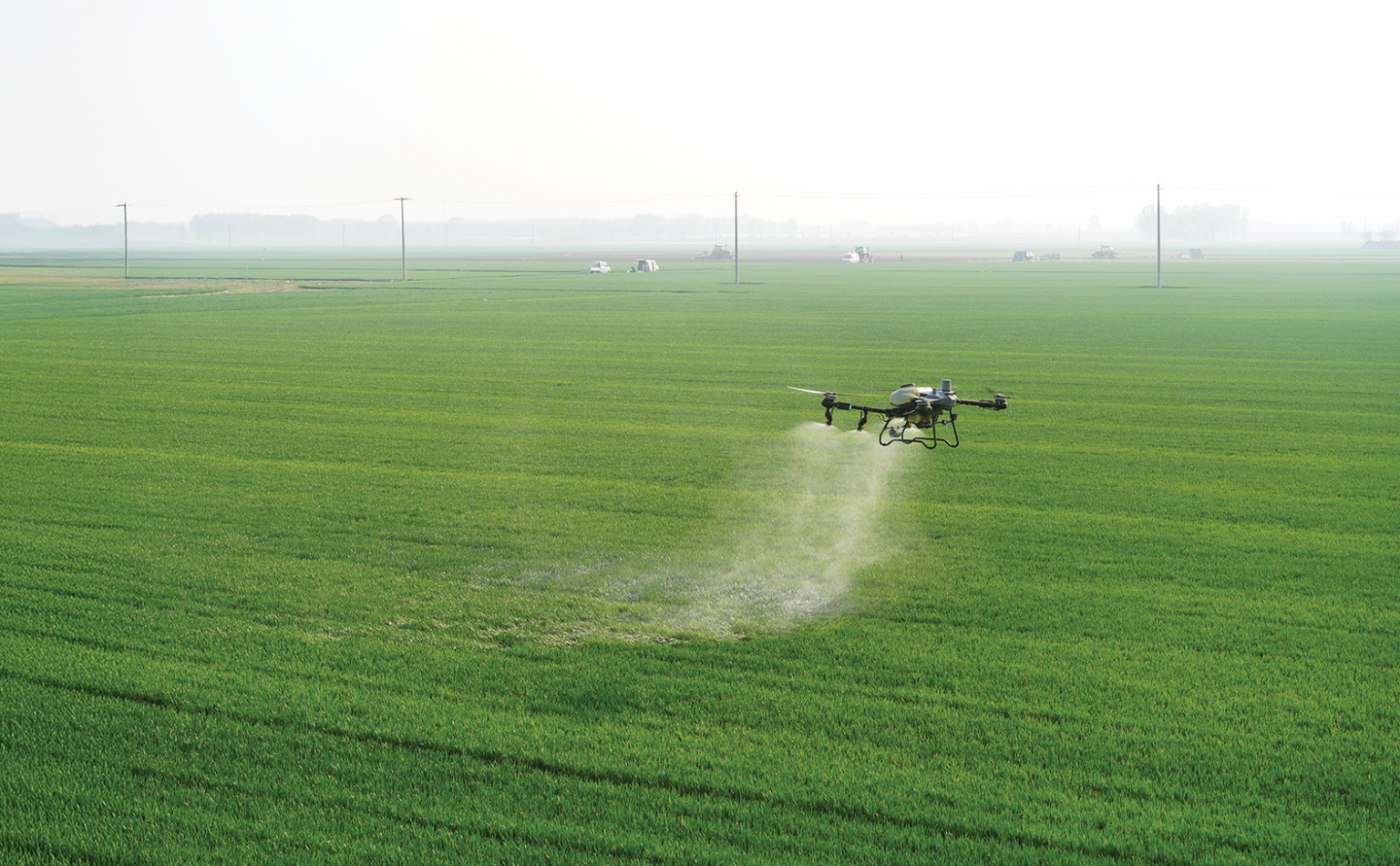
A symposium on drones for weed control highlighted some of the recent work within Canada and the U.S. A total of 14 studies were presented at this symposium and throughout other topic areas of the proceedings.
Presenters were concerned about the poor patterns from drones, but some were surprised that weed control was still achieved. It was stressed that spray deposition from drones is more complex than from other types of sprayers, being dependent on flying height and speed, droplet size, application volume and ambient wind conditions. Risks from droplet evaporation are also greater due to smaller droplets being used with drones.
Studies looking at swath width on bare ground versus various crop canopies showed that drone swaths can be 30 per cent narrower within a dense crop than on bare ground. This could result in insufficient overlapping between spray passes, resulting in striping.
Some wind tunnel sizing work showed that the droplet sizes reported by the DJI T40 rotary atomizers were actually finer by one category than the drone manufacturer reported. This will have implications for compliance with pesticide labels where a spray quality is prescribed for drift control.
Several studies reported on herbicide efficacy with drones. One experiment showed that a coarse spray at three gallons per acre (gpa) applied with a drone resulted in less weed control than was achieved with finer drone sprays or higher volumes from ground sprays.
Two additional studies showed that a minimum of five gpa was needed to obtain acceptable control. In the first study of water hemp with glufosinate and 2,4-D choline, two and three gpa provided significantly lower control than the higher volume. A similar result was reported for the second study, this time with pre-emergent herbicides.
These results make sense. Very low water volumes do need more small droplets to achieve adequate coverage (droplets per square centimetre). Drift control is not as easy to achieve with larger droplets because coverage is reduced too much.
There were plenty of interesting studies. One researcher used a cattle prod to control weeds, measuring the duration of the prod needed for best control. It could take some time to cover a whole field this way, but may make sense in small areas. Another showed the incredible utility of weed maps generated with computer vision, a valuable tool in monitoring patches and population dynamics. A third used interplanted soybeans within a soybean crop to suppress weeds, with the interplanted rows later being terminated.
I started attending weed science conferences in 1989. We were still in a golden age of discovery. Elaborate new herbicide introductions were annual events. “Weed research” was dominated by showing how well weeds died after herbicide application. Herbicide resistance was in its infancy. Weed ecology was fledgling. Integrated management was not a common term. All our eggs were in the herbicide basket.
Thirty-seven years later, weed science is alive and well. Importantly, we now have many baskets for weed control. Yes, this NCWSS meeting was still dominated by herbicide evaluations, but many of these were in the context of maintaining control of resistant weeds. There were very few product introductions that weren’t simply a new mixture of existing products.
New application techniques dominated the proceedings more than others in recent memory. Drones are getting a lot of attention, but could be a brief infatuation unless deposit uniformity can be improved and water volumes can increase to more reasonable levels. The spot spray revolution, on the other hand, received some solid scientific backing and offers enticing options for resistant weed management and product savings. This technology has been on a path towards improvement in detection accuracy, and its power will only strengthen with time.
But the most noticeable aspect for me was the rise of cover crops as a management tool. Cover crops are not new. They preceded herbicides by generations, if not millennia. The overall ability of cover crops to reduce weed populations in the absence of herbicides points to their strength – being a non-herbicidal practice that ultimately reduces reliance on herbicides and thus reduces the detrimental effect of herbicide-resistant weeds.
Ultimately, weed science will need to return to its roots. Roots based on an integration of all available agronomic and technological tools to prevent weed emergence, competition, reproduction and spread. The pieces are there. The next step is to make this level of integration practical and cost-effective. I believe we are on our way there.