


By Angela Lovell
When Sheldon Wiebe attended a conference five years ago, hosted by EMILI (Enterprise Machine Intelligence & Learning Initiative), he didn’t expect it would result in a partnership that is bringing cutting-edge artificial intelligence (AI) technology to his family farm at MacGregor, Manitoba.
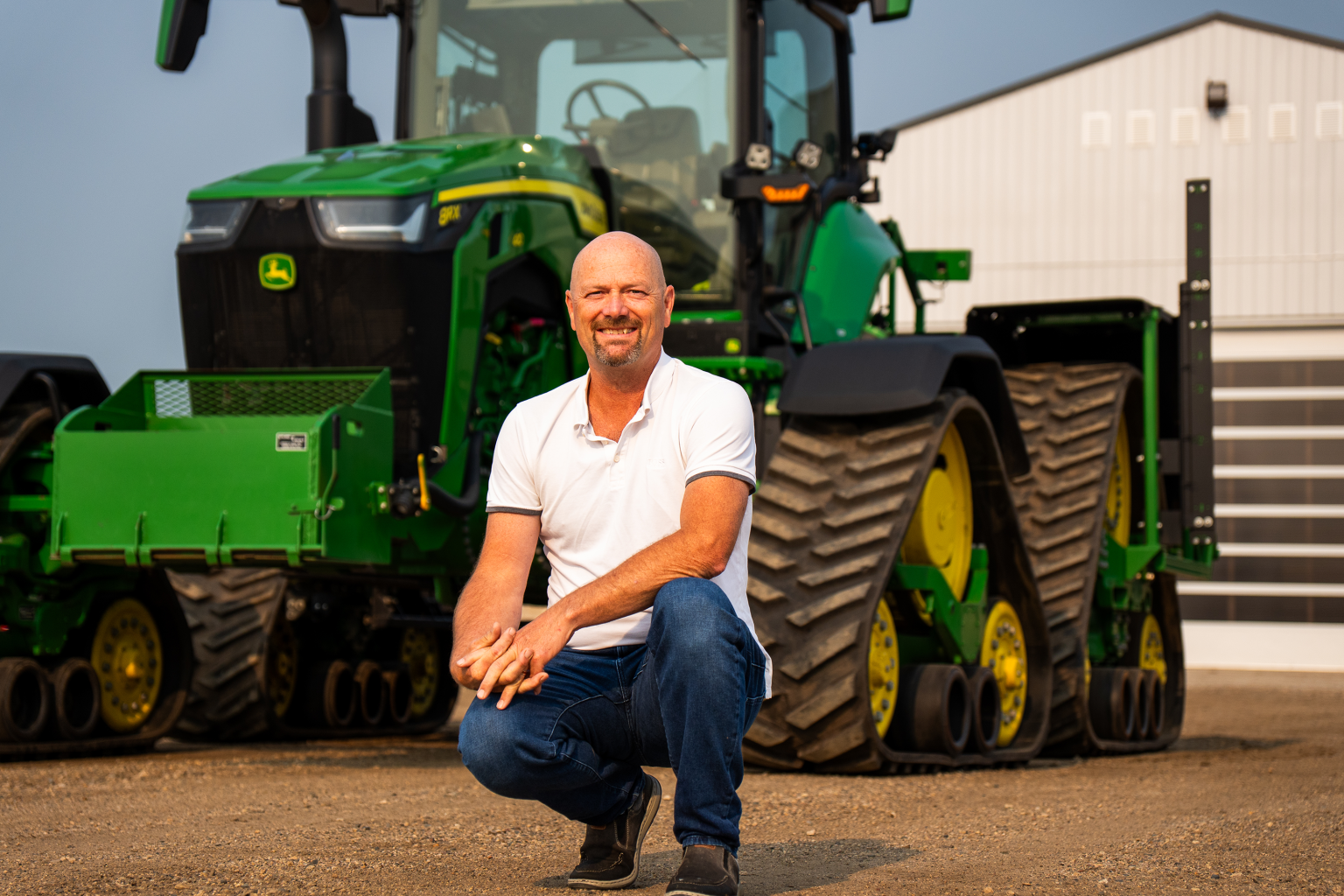
J.P. Wiebe Ltd., a 10,000-acre farm that grows grain, oilseeds and 3,000 acres of potatoes annually, is one of EMILI’s two Innovation Farms. Owner and president Sheldon Wiebe and his wife Jennifer, also his business partner, represent the third generation on the farm, working alongside their three sons – Ryan, Evan and Jason – and daughter, Jordyn.
With a 20-year track record of adopting innovations like variable rate fertilization, the Wiebes were eager to experiment with EMILI’s AI systems at a field scale on their farm.
“EMILI has leased a couple of fields where they do the technology projects and they are self-sufficient; we don’t have anything to do with it other than helping them with good placement, and then we can utilize the results if we want,” says Wiebe. “But they do brainstorm with us to see what the industry is looking for. We talk to them about our challenges and they go out and look for solutions. Or, if we see something, we will bring it to the table and say, ‘What about this product? Are you interested?’ and they will do the R&D on it. They are very good to work with. It’s a good partnership.”
AI projects on the farm
EMILI projects on the farm include BioScout testing, an airborne spore monitoring system originally developed in Australia that detects diseases such as early blight or late blight before becoming visible in the crop. Sensors collect spores and then AI detects disease particles, sends the data to a dashboard, and sends alerts to the producer’s mobile device regarding any issues. The aim is early disease detection to allow producers to manage it more quickly to effectively reduce crop damage.
Although the data is still being collected and it will be a while before EMILI can share results with the farm, Wiebe says their in-house agronomist is already excited about the system.
“If it gives an edge on fungicide treatment or timing by being proactive rather than reactive, that will get us ahead of the game,” Wiebe says.
The Wiebes are also trialing an autonomous pivot, although it’s not their first. They have had autonomous pivots that manage water use on the farm for about three years, but the new model takes it a stage further. It uses AI to combine sensor data, crop growth stages, weather forecasts and intelligent learning to optimize irrigation and send alerts about any pest or disease issues.
“It is like an onboard soil-sensing, moisture-sensing tool that reads the moisture as it goes; there are no soil probes. It has cameras and takes pictures of pests or blight areas or whatever you are looking for, and gives you really good data to work with,” Wiebe says. “We have over 40 pivots on our farm, and it’s crucial with our very sandy soil type that they work well all the time. If we can get a technology that helps with that, it enhances what we can do.”
Monitoring storage with digital technology
The farm has a number of potato storages, and inside one of them EMILI is testing a Cellar Insights Smart Storage unit designed to help ensure optimal storage conditions. It can sense potato rot, monitor temperature, humidity and carbon dioxide, and deliver early warnings on spoilage risk, shrink and quality issues in the crop.
“It helps sense if there is an issue in your storage and lets you know remotely, rather than just relying on human interaction with your storage,” Wiebe says. “It does help, especially when you have multiple storages, as we do.”
Deployed at 15 locations across the farm in various crop types over the last couple of years is the Agi3 Crop Sentry system, an AI-driven IoT (Internet of Things) platform that provides 24-7 crop monitoring and analytics. It is equipped with long-range LiDAR (light detection and ranging), high-resolution multispectral cameras that measure crop growth and health, and also integrates weather data with wireless soil moisture data. The goal is to test the system’s ability to monitor crop performance and predict yields based on in-season changes.
The most recent project, started in 2026, is evaluating Irrigated Farming Ultra, a hardware and software solution from Crop Intelligence that combines wireless soil moisture probes and rain buckets with a weather station to measure water-driven yield potential to determine how much irrigation is needed to reach target yields.
Ultimately, the aim of all this digital AI technology is to improve the efficiency, yield and quality of the crops grown on the farm, and that’s particularly important for potatoes.
“Our potato contracts are driven by quality,” Wiebe says. “There are a lot of quality aspects that we have to meet and if we do that, we are always looking at more return.”
The benefits of technology
Technology has definitely made a difference to the farm, making operations more efficient and helping utilize human resources more effectively.
“We can be more efficient in placement of water and fertilizer, and it helps with labour management because you can do more with less people as long as you trust the system,” Wiebe says. “We can use our people in different areas, and even have people who aren’t as skilled do more because of the technology. They just have to maintain it or do the work that is needed.”
Wiebe is waiting for the results of the EMILI projects before deciding if he will permanently adopt these AI technologies on the farm, but he’s reasonably sure they will stay.
“The downfall always with anything new is if it’s wrong then you could go down the wrong path with it,” he says. “That’s where it is nice working with EMILI because they are taking products to a field scale right away rather than just plots, so that helps you gain confidence in the products that they are trying.”
There is a lot going on, but the Wiebes have help, with their sons Ryan and Evan running the day-to-day operations, including the farm’s 17 full-time employees. Meanwhile, son Jason manages the irrigation, while daughter Jordyn takes care of the books and the complex food safety requirements. With the economics of farming today, and the rapid growth of the farm over the last few years, the short-term plan is to benefit from the investments they have already made.
“We have done some major expansions over the years, but with all of the pressure of fertility pricing and fuel and labour, it puts a damper on how much more of your equity you can outlay,” Wiebe says. “The plan right now is to stay as status quo as we can, build our equity back up a bit and see where it goes in a few years.”
But they will always keep an eye out for innovative technologies that could bring more value to the farm.
“Our focus is on soil health and will always be, but maybe there is a fit for AI there too in the future,” Wiebe says.


